Доминиканский янтарь
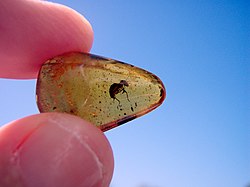
Рабочий термит в куске Доминиканского янтаря

Оса дриинида в куске Доминиканского янтаря

Самка ископаемой пчелы Oligochlora semirugosa из Доминиканского янтаря

Самка ископаемой пчелы Nesagapostemon moronei из Доминиканского янтаря
Доминиканский янтарь — вид янтаря (самый массовый в тропиках и второй в мире после балтийского янтаря), обнаруживаемый в восточной части острова Гаити (Карибское море) в Доминиканской Республике[1].
Содержание
1 Описание
2 Возраст
3 Флора доминиканского янтаря
4 Фауна доминиканского янтаря
5 Примечания
6 Литература
7 Ссылки
Описание |
Доминиканский янтарь чаще бывает жёлтого цвета, а также красного, зелёного и, значительно реже, синего цвета[en][2][3].
Синий янтарь встречается, главным образом, в шахте Пало Кемадо (Palo Quemado mine) к югу от La Cumbre[4].
Все месторождения доминиканского янтаря занимают площадь около 400 км² в горах Кордильера-Септентриональ на высоте 500–1000 метров над уровнем моря[5]. Среди крупных месторождений La Cumbre, La Toca, Palo Quemado, La Bucara, Los Cacaos[6], Bayaguana/Sabana de la Mar и другие[7].
Коллекции доминиканского янтаря демонстрируются в музее янтаря Museo del Ambar Dominicano (Сан-Фелипе-де-Пуэрто-Плата), а также в музее Amber World Museum в Санто-Доминго.
Доминиканский янтарь образовался из окаменевшей смолы ископаемого дерева Hymenaea protera (род Hymenaea, семейство Бобовые). От самого массового и известного балтийского янтаря отличается большей прозрачностью и относительно большим количеством ископаемых включений, инклюзов. Это позволило подробно восстановить структуру давно исчезнувших экосистем тропических лесов[1].

Голубой доминиканский янтарь

Порода с янтарями

Зелёный доминиканский янтарь


Возраст |
Возраст янтаря из доминиканского месторождения первоначально был определён в ~40 млн лет (эоцен)[8], но впоследствии такая датировка была оспорена и указан возраст 23—30 (олигоцен)[9] или 15—20 (миоцен)[10] млн лет.
В результате сравнительного анализа возраста разных видов янтаря были получены следующие данные (в млн. лет)[11]:
- Доминиканский (Доминик. Респ.) — 15—40
Мексиканский янтарь (Чьяпас) — 22—26
Балтийский янтарь — около 40- Hat Creek (Британская Колумбия, Канада) — 50—55
- Канадский (Альберта, Манитоба) — 70—80
- Нью-Джерсийский (США) — 65—95
Бирманский (Мьянма) — 97—105
Таймырский (Сибирь, Россия) — 78—115- Испанский (Алава, San Just) — 100—115
- Французский (пров.Приморская Шаранта) — 100—105
- Ливанский (Ливан) — 130—135[12]
Ровенский янтарь (Украина, г. Ровно) — около 40
Флора доминиканского янтаря |
- Hymenaea protera
- Palaeoraphe
- Roystonea palaea
Фауна доминиканского янтаря |
См. также Инклюзы доминиканского янтаря
Более 400 видов ископаемых насекомых из 21 отряда описано из доминиканского янтаря (Arillo & Ortuño, 2005), а первой стала безжальная пчела Proplebeia dominicana (Wille & Chandler, 1964)[13][14].
Acanthognathus poinari Baroni Urbani, 1994 (муравей)[15]
- Anochetus conisquamis
- Anochetus exstinctus
Apterostigma eowilsoni (муравьи-грибководы)[16]
Araneagryllus (сверчки)
Archeatelura Mendes, 1997[17]
Augochlora leptoloba (пчела)
Bocchus vetustus Olmi, 1989 (оса)[18]
Cephalotes serratus[19]
Dryinus grimaldii (оса)- Dryinus rasnitsyni
Eickwortapis (пчела)
Electromyrmococcus[20]
Leptofoenus pittfieldae (наездник)
Lutzomyia adiketis[21]
Neocorynura electra (пчела)
Nesagapostemon (пчела)
Nesomyrmex dominicanus (de Andrade, 1999) (муравей)[22]
Oligochlora (пчела)
Oxyidris[23]
Paleoleishmania neotropicum (трипаносомы)[21]
Paraponera dieteri Baroni Urbani, 1994[24][25]
Protopaussus pristinus Nagel, 1997[26]
Pulex larimerius Lewis et Grimaldi, 1997 (блохи)[27]
Sphaerodactylus dommeli[28]
Tainosia (цикадка)[29]
Termitaradus mitnicki (клопы)
Triatoma dominicana (клопы)
Trypanosoma antiquus (трипаносомы)
Tyrannasorus rex (жуки)
Примечания |
↑ 12 George Poinar, Jr. and Roberta Poinar, 1999. The Amber Forest: A Reconstruction of a Vanished World, (Princeton University Press) ISBN 0-691-02888-5
↑ Schlee, D. (1980): Bernstein-Raritaeten (Farben, Strukturen, Fossilen, Handwerk). — 88 S. (mit 55 Farbtafeln); Staatl. Museum für Naturkunde Stuttgart.
↑ L. Linati and D. Sacchi, V. Bellani, E. Giulotto (2005). “The origin of the blue fluorescence in Dominican amber”. J. Appl. Phys. 97: 016101. DOI:10.1063/1.1829395..mw-parser-output cite.citation{font-style:inherit}.mw-parser-output q{quotes:"""""""'""'"}.mw-parser-output code.cs1-code{color:inherit;background:inherit;border:inherit;padding:inherit}.mw-parser-output .cs1-lock-free a{background:url("//upload.wikimedia.org/wikipedia/commons/thumb/6/65/Lock-green.svg/9px-Lock-green.svg.png")no-repeat;background-position:right .1em center}.mw-parser-output .cs1-lock-limited a,.mw-parser-output .cs1-lock-registration a{background:url("//upload.wikimedia.org/wikipedia/commons/thumb/d/d6/Lock-gray-alt-2.svg/9px-Lock-gray-alt-2.svg.png")no-repeat;background-position:right .1em center}.mw-parser-output .cs1-lock-subscription a{background:url("//upload.wikimedia.org/wikipedia/commons/thumb/a/aa/Lock-red-alt-2.svg/9px-Lock-red-alt-2.svg.png")no-repeat;background-position:right .1em center}.mw-parser-output .cs1-subscription,.mw-parser-output .cs1-registration{color:#555}.mw-parser-output .cs1-subscription span,.mw-parser-output .cs1-registration span{border-bottom:1px dotted;cursor:help}.mw-parser-output .cs1-hidden-error{display:none;font-size:100%}.mw-parser-output .cs1-visible-error{font-size:100%}.mw-parser-output .cs1-subscription,.mw-parser-output .cs1-registration,.mw-parser-output .cs1-format{font-size:95%}.mw-parser-output .cs1-kern-left,.mw-parser-output .cs1-kern-wl-left{padding-left:0.2em}.mw-parser-output .cs1-kern-right,.mw-parser-output .cs1-kern-wl-right{padding-right:0.2em}
↑ Palo Quemado blue amber mine (неопр.). Wondermondo. Архивировано 3 сентября 2013 года.
↑ Amer. Journ. Bot., 1997, p. 982.
↑ Corday, Alec Dominican Amber Mines: The Definitive List (неопр.). The Blue Amber Blog (2006). Проверено 15 апреля 2008. Архивировано 20 апреля 2008 года.
↑ Schlee, D. (1984): Notizen über einige Bernsteine und Kopale aus aller Welt. Stuttgarter Beitr. Naturk. Ser. C, 18: 29—47, page 35
↑ Lambert J. B., Frye J. S., Poinar G. O., Jr. Amber from the Dominican Republic: analysis by nuclear magnetic resonance spectroscopy // Archaeometry. — 1985. — № 27. — P. 43—51.
↑ Grimaldi D. On the age of Dominican amber // Amber, resinites and fossil resins / K. B. Anderson, J. C. Crelling (eds.). — Washington, DC: American Chemical Society, 1995. — P. 203—217.
↑ Iturralde-Vinent M. A., MacPhee R. D. E. Age and paleoecological origin of Dominican amber // Science. — 1996. — № 237. — P. 1850—1852.
↑ George Poinar, Jr. Amber // Encyclopedia of Insects / Vincent H. Resh & Ring T. Cardé. — 2nd. — Academic Press, 2009. — P. 8–11. — ISBN 9780123741448.
↑ Poinar, G.O.Jr. & Milki, R. (2001). Lebanese amber. The oldest ecosystem in fossilized resin. — Oregon State University Press, Corvallis, 96 pp.
↑ Antonio Arillo & Vicente M. Ortuño. 2005. Catalogue of fossil insect species described from Dominican amber (Miocene). — Stuttgarter Beiträge zur Naturkunde Serie B (Geologie und Paläontologie). — Nr. 352. — S. 1—68 (Staatliches Museum für Naturkunde, Stuttgart)
↑ Pérez-Gelabert, D. E. (1999): Catálogo Sistemático y Bibliografía de la Biota Fósil en ámbar de la República Dominicana. — Hispaniolana, 1: 1—65.
↑ Baroni Urbani C., De Andrade M. L. 1994. First description of fossil Dacetini ants with a critical analysis of the current classification of the tribe (Amber Collection Stuttgart: Hymenoptera, Formicidae. VI: Dacetini). Stuttgarter Beitrage zur Naturkunde (B), 198: 1—65.
↑ Schultz, T.R. 2007: The fungus-growing ant genus Apterostigma in Dominican amber. In: Advances in Ant Systematics (Hymenoptera: Formicidae): Homage to E.O. Wilson — 50 Years of Contributions (R.R. Snelling, B.L. Fisher, and P.S. Ward, Eds.). — Memoirs of the American Entomological Institute, 80: 425—436.
↑ Mendes, L. F. 1997: First contribution to the study of the Dominican amber Zygentoma (Insecta). Family Ateluridae. Pedobiologia, 41: 40—43.
↑ Olmi, M.; Rasnitsyn, A.P.; Guglielmino, A. 2010: Revision of rock fossils of Dryinidae and Embolemidae (Hymenoptera: Chrysidoidea). Zootaxa, 2499: 21-38.
↑ Poinar, George. Nematode Parasites and Associates of Ants: Past and Present (англ.) // Psyche. — 2012. — Vol. 2012, no. ID 192017. — P. 1—13. doi:10.1155/2012/192017
↑ Johnson M.S., et; et al. (2001). “Acropyga and Azteca Ants (Hymenoptera: Formicidae) with Scale Insects (Sternorrhyncha: Coccoidea): 20 Million Years of Intimate Symbiosis”. American Museum Novitates. 3335: 1—18. DOI:10.1206/0003-0082(2001)335<0001:AAAAHF>2.0.CO;2.
↑ 12 Poinar G. (2008). “Lutzomyia adiketis sp. n. (Diptera: Phlebotomidae), a vector of Paleoleishmania neotropicum sp. n. (Kinetoplastida: Trypanosomatidae) in Dominican amber”. Parasites & Vectors. 1 (1): 22. DOI:10.1186/1756-3305-1-22. PMC 2491605. PMID 18627624.
↑ de Andrade, M. L., C. Baroni Urbani & C. R. F. Brandão. (1999). Two new species of Leptothorax Nesomyrmex fossils in Dominican amber (Hymenoptera: Formicidae). Beitraege zur Entomologie, 49(1): 133—140.
↑ Wilson, E. O. Ants of the Dominican amber. 1. Two new myrmicine genera and an aberrantPheidole (англ.) // Psyche. — 1985. — Vol. 92. — P. 1—9.
↑ Baroni Urbani, C. (1994). The identity of the Dominican Paraponera (Amber Collection Stuttgart: Hymenoptera, Formicidae. V: Ponerinae, partim). Stuttg. Beitr. Naturkd. Ser. B (Geol. Palaontol.) 197: 1-9.
↑ Wilson, E. O. (1986 («1985»)). Ants of the Dominican amber (Hymenoptera: Formicidae). 4. A giant ponerine in the genus Paraponera. Isr. J. Entomol. 19: 197—200.
↑ Nagel P. New fossil paussids from Dominican amber with notes on the phylogenetic systematics of the paussine complex (Coleoptera: Carabidae). Systematic Entomology 22, 4, 345—362 (1997) DOI:10.1046/j.1365-3113.1997.d01-51.x
↑ Lewis Robert E. and David Grimaldi. (1997). A Pulicid Flea in Miocene Amber from the Dominican Republic (Insecta: Siphonaptera: Pulicidae). — American Museum Novitactes. Number 3205, 9 pp., 2 figures. — American Museum of natural history. New York, N.Y. (August 29, 1997)
↑ Daza Juan Diego, Bauer, A. M., Wagner, P. and Böhme, W. (Jan 1, 2012 (26 Sep 2012 online)). “http://onlinelibrary.wiley.com/doi/10.1111/jzs.12001/abstract A reconsideration of Sphaerodactylus dommeli Böhme, 1984 (Squamata: Gekkota: Sphaerodactylidae), a Miocene lizard in amber”. Journal of Zoological Systematics and Evolutionary Research. Wiley Online Library. DOI:10.1111/jzs.12001. ISSN 1439-0469.Subsequent to the acceptance of this paper, we obtained high resolution X-ray computed tomography imagery for the paratype of Sphaerodactylus dommeli that confirms that it is correctly allocated to genus. Details of its osteology will be reported elsewhere.
Проверьте дату в|date=(справка на английском); Внешняя ссылка в|title=(справка на английском)
↑ Szwedo J., Stroiński A. (2001). “Tainosia quisqueyae gen. and sp. nov. from the Oligocene/Miocene Dominican amber (Hemiptera: Fulgoroidea: Nogodinidae)” (PDF). Genus. 12 (1): 29—34.
Литература |
- Фащук Д. Я. Морской ладан (недоступная ссылка) «Химия и жизнь», 2005, № 3. С.54—59. (рус.)
- Яблоков-Хнзорян С. М. 1961. Насекомые в янтаре. — Природа. No3: 57—60.
- Grimaldi D.A. 1996. Amber. Window to the Past. — Harry N. Abrams, Inc. Publ. A.M.N.H.
- David Penney (Ed.): Biodiversity of Fossils in Amber from the Major World Deposits. Siri Scientific Press, 2010: 304 pp.
- Hibbett D. S., Grimaldi D., Donoghue M. J. Fossil Mushrooms from Miocene and Cretaceous Ambers and the Evolution of Homobasidiomycetes (англ.) // Amer. Journ. Bot. — 1997. — Vol. 84, no. 7. — P. 981—991.
Ссылки |
- Кирейчук А. Г. Жуки в янтаре (рус.)
- PBS NOVA «Amber: Jewel of the Earth»
‘Surprising’ lizards in amber. by David Catchpoole
American Museum of Natural History: Amber.
Life in Amber includes numerous further links- Christine Lipkin, «Geological setting and age of the Dominican Republic»
- Dominican Amber Mines: The Definitive List


